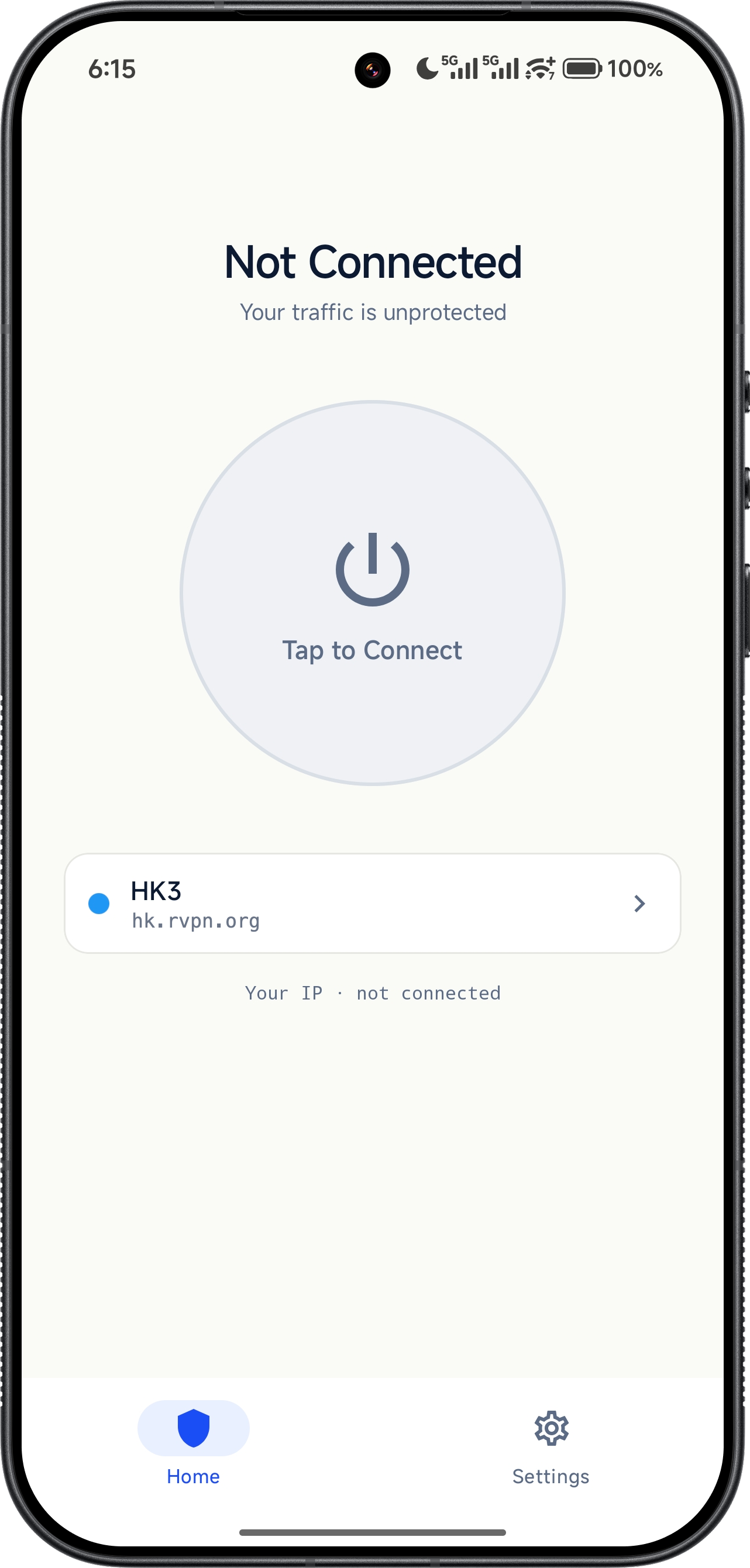
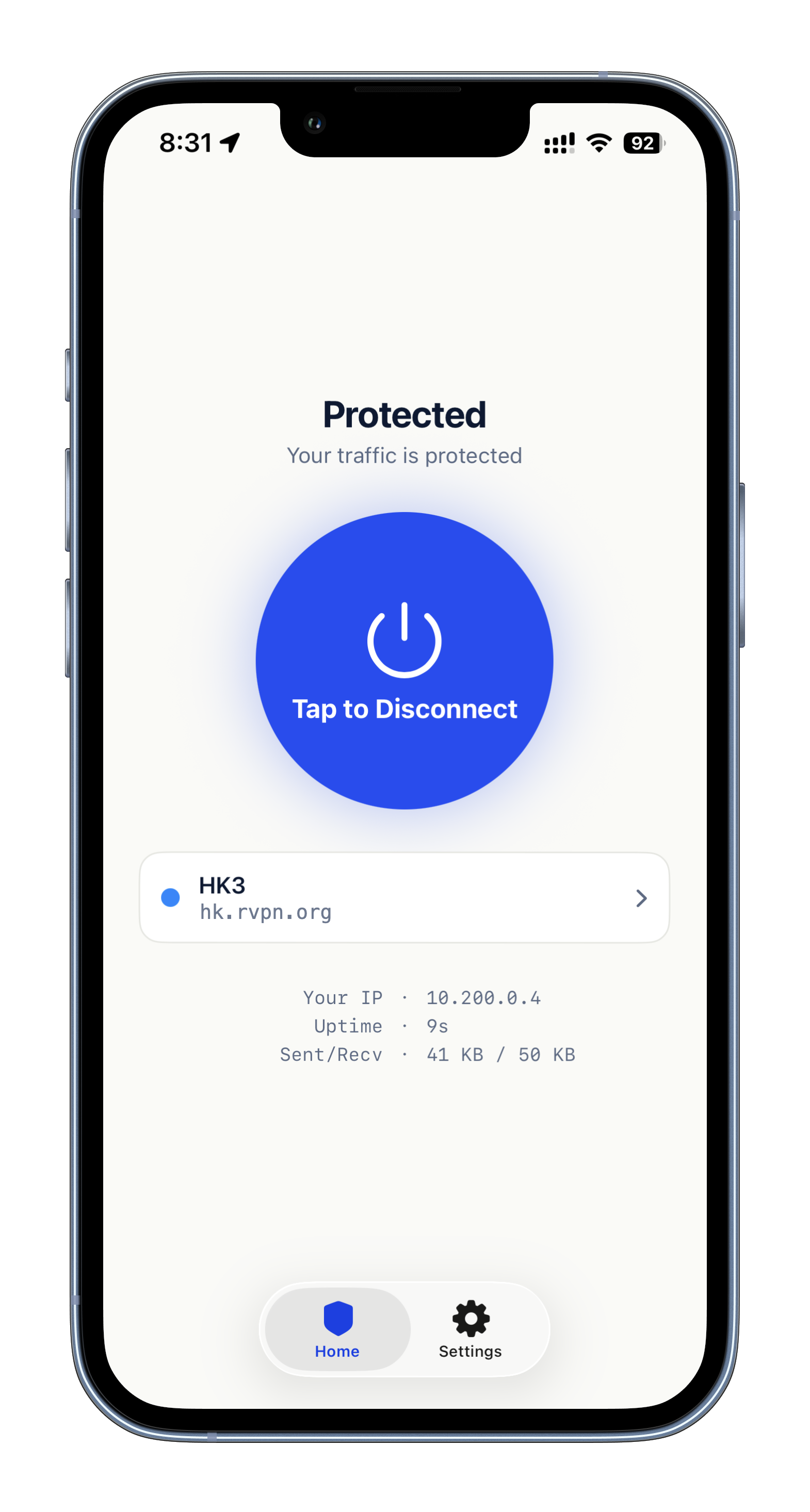
v1.2.3 stable release

Privacy you can verify, not just promise.

Commercial VPNs ask you to trust a no-logs policy. rVPN replaces that trust with open-source cryptography. A Rust-built transport protocol that runs over a single, indistinguishable connection on port 443.

curl -fsSL https://assets.rvpn.org/install.sh | sudo bash
ratchet.rs
pub struct DoubleRatchet {
    // DH ratchet for post-compromise security
    dh_pair: Option<X25519KeyPair>,
    remote_dh_key: Option<X25519PublicKey>,

    // Symmetric ratchet for forward secrecy
    root_key: [u8; 32],
    sending_chain_key: Option<[u8; 32]>,
    receiving_chain_key: Option<[u8; 32]>,

    // Defeats traffic analysis via ML heuristics
    padding_strategy: ConstantRate,
}
Architecture

A pipeline you can audit at every stage.

Traffic moves through four distinct stages before it reaches the open internet. Each stage is open-source and independently verifiable. Nothing happens inside a black box.

rVPN traffic routing diagram Client traffic splits three ways: local traffic goes direct, tracker traffic is dropped at a sinkhole, and remaining traffic is multiplexed through port 443, where unauthenticated probes are sent to a decoy site while authenticated traffic passes through the ratchet core to the internet. Your device client Tracker sinkhole 0.0.0.0: dropped Local network LAN: direct Gateway :443 multiplex Decoy website served on unauth probe Ratchet core Ratchet core Internet target reached
Encrypted tunnel Local / dropped traffic Served only to unauthenticated probes
01 Client

Smart split tunnelling

Local and LAN-bound traffic routes back to your network directly. Known ad and tracker domains are dropped at a local sinkhole before they reach the tunnel, saving bandwidth and reducing noise.

02 Gateway

Active probing defence

If a network operator attempts to fingerprint the connection with an unauthenticated probe, the gateway invisibly serves a real decoy website. From the outside, the connection looks like ordinary HTTPS.

03 Core

Zero-trust cryptography

Authenticated traffic is handled by the Double Ratchet algorithm with X3DH key agreement. Even if a server is later seized, past sessions remain unreadable. Forward secrecy is mathematical, not contractual.

04 Exit

Secure DNS resolution

Every DNS query is resolved inside the encrypted tunnel. Your ISP and local network see a single multiplexed connection on port 443. Nothing more.

Technical specification

How rVPN compares to other transports.

A direct comparison against widely-used open-source VPN and proxy protocols.

Feature rVPN WireGuard Brook VLESS / Xray
Transport layer WSS / TLS 1.3 UDP Custom TCP / UDP Various
Port operation 443 (standard HTTPS) Any Any Any
Post-compromise security Yes, ratchet No No No
Active probing resistance Decoy intercept None Silent drop Reality (partial)
Post-quantum support On roadmap Not natively No No
Trust model

Code you can audit, instead of a policy you can't.

Most commercial VPNs are closed-source clients connecting to centralised infrastructure. rVPN is fully open source, so every claim below is something you can independently verify.

Commercial incumbents vs rVPN

Closed-source client with undisclosed telemetry

100% open-source client and core. Fully auditable.

Centralised infrastructure under one corporate entity

Traffic passes as standard HTTPS over TLS 1.3

Privacy guaranteed by a written no-logs policy

Forward secrecy enforced by the Double Ratchet algorithm

WireGuard and OpenVPN signatures are easily flagged by network filters

No telemetry collection by design, not by promise

Performance

Built in Rust. Runs on Raspberry Pi.

rVPN's core is written in Rust with no garbage collector and no legacy runtime overhead. It's small enough to run a full secure tunnel for a small office on a single board computer.

Binary size
~5 MB
Memory footprint
~35 MB
Garbage collection
None
Minimum hardware
Raspberry Pi
Availability

Available everywhere it matters.

Core binaries are free and open source under AGPLv3. Premium mobile clients fund ongoing protocol development.

Component Platforms License Access
Core & desktop binaries macOS, Linux, FreeBSD: x86_64 / ARM64 AGPLv3, open source Download →
Official mobile clients iOS, Android, HarmonyOS Commercial, funds development App stores →
Custom & third-party GUIs Any platform via core engine API AGPLv3, open source Developer guide →